


Views: 0 Author: Site Editor Publish Time: 2026-06-10 Origin: Site


Consumers often use the terms "biscuit" and "cookie" interchangeably when browsing grocery aisles. However, industrial baking treats them as entirely distinct categories. Producing these items at scale requires distinctly different dough handling and forming machinery. Investing in the wrong line configuration limits your future product portfolio expansion. It dramatically increases changeover downtime. It also frequently causes costly dough-handling bottlenecks on the factory floor. Plant managers often face expensive retrofits when their chosen equipment fails to match specific dough rheology. This article clarifies the mechanical differences between these manufacturing paths. You will learn how to evaluate plant layout and modularity options effectively. We provide a clear roadmap to help plant managers and investors choose the optimal setup. You can then confidently scale production, ensure compliance, and capture emerging market trends.
Dough dictates the equipment: Biscuit lines rely on sheeting, laminating, and rotary moulding (low moisture/fat), whereas cookie lines require wire-cutting or depositing (high fat/sugar).
Tunnel oven configurations overlap: Both lines generally utilize similar tunnel ovens (Direct Gas Fired, Convection, or Hybrid), meaning the primary equipment variance occurs in the forming stage.
Hybrid lines are viable but complex: A combined biscuit and cookie production solution requires modular forming stations, which increases initial footprint and CapEx but maximizes long-term product flexibility.
You cannot effectively select bakery equipment without first understanding dough rheology. The physical properties of your raw mixture dictate every mechanical step. Dough consistency determines whether you need gauge rollers, wire harps, or heated depositing nozzles.
Hard biscuits, such as crackers and Marie biscuits, demand rigorous physical development. The dough requires continuous sheeting to develop strong gluten networks. Manufacturers use multi-stage gauge rollers to reduce the dough sheet thickness gradually. This precise reduction prevents the dough from shrinking during baking. Soft biscuits operate under a different set of rules. Their dough contains higher fat levels and less water. It forms a crumbly texture. You cannot sheet soft biscuit dough easily. Instead, you must use rotary moulding. A rotary moulder presses the crumbly mass into engraved die cavities to form distinct shapes.
Cookie dough behaves completely differently. It is highly cohesive, sticky, and typically rich in fat. It often contains heavy inclusions like chocolate chips, fruit pieces, or nuts. You cannot pass this mixture through traditional sheeting rollers. The fat content would cause sticking, and the rollers would crush the inclusions. Cookie dough requires extrusion. You must process it using wire-cut machines or volumetric depositors.
A mismatch between dough type and machinery brings production to a halt. You cannot force sticky cookie dough through a biscuit rotary moulder. The dough will refuse to release from the die cavities. Conversely, you cannot wire-cut a laminated cracker dough. Defining your exact product matrix is the mandatory first step. Plant managers must document every recipe before consulting equipment manufacturers. This prevents critical processing bottlenecks down the line.
Ignoring inclusion sizes: Buying a standard depositor when your recipe uses large chocolate chunks leads to clogged nozzles.
Underestimating dough rest times: Hard biscuit dough needs relaxation time to prevent oval-shaped final products.
Building a complete biscuit production line requires synchronizing several specialized modules. Each component must handle low-moisture dough precisely. Let us break down the distinct sections.
Biscuit manufacturing begins inside robust horizontal mixers. Hard biscuit dough requires high-friction mixing to develop the gluten matrix fully. The mixer blades stretch and fold the dense mass vigorously. Soft biscuit dough requires a gentler approach to prevent over-mixing. Over-mixed soft dough becomes tough and loses its desirable short texture.
The forming stage defines the entire biscuit facility. Hard biscuits run through heavy-duty laminators. The laminator folds the dough into multiple overlapping layers. This creates the signature flaky texture found in premium crackers. Multi-stage gauge rollers then flatten the dough sheet. Finally, a rotary cutter stamps out individual pieces.
Soft biscuits skip the lamination process. The crumbly dough drops directly into a rotary moulder hopper. A forcing roller pushes the mixture into a custom-engraved die roll. A scraper blade removes excess dough. A rubber extraction web then pulls the perfectly formed shapes out of the die.
The formed pieces transfer onto a steel wire mesh or solid steel baking band. They travel continuously through a multi-zone tunnel oven. Operators typically configure these ovens using Direct Gas Fired (DGF) zones initially to achieve rapid lift. Convection zones follow to remove moisture evenly. After exiting the oven, the biscuits travel along extensive cooling conveyors. Natural ambient cooling or forced-air systems reduce the product temperature before packaging. Rapid cooling prevents condensation inside the final wrapper.
Hard biscuit production generates significant edge waste. When the rotary cutter stamps round or rectangular shapes, a lattice of webbing remains. An efficient line recycles this scrap seamlessly. Conveyors lift the leftover dough web and transport it back to the initial hopper. It blends uniformly into fresh dough to minimize waste.
Operating an automatic cookie production line involves managing sticky, delicate matrices. The machinery must preserve inclusions while delivering accurate volumetric portions.
Pumping sticky cookie dough requires specialized handling. Facilities use automated dough feeding systems equipped with kibblers. A kibbler gently chops large chunks of dough into manageable pieces. It drops these pieces evenly across the forming hopper. This process prevents the dough from bridging and maintains a constant head pressure. Constant pressure ensures accurate weight control.
Cookie forming relies heavily on extrusion technology rather than compression.
Wire-Cut Machines: Extrusion rollers push the dough through a row of dies. A mechanically driven wire harp slices across the die openings. It drops uniform dough pieces directly onto the oven band. This method handles chocolate chips and nuts beautifully without crushing them.
Depositors: Facilities use these for semi-liquid or soft recipes like butter cookies, spritz cookies, or macarons. Depositors drop precise volumetric amounts of batter through customized nozzles.
Encrusting Machines: These specialized units produce center-filled cookies. They co-extrude an outer dough casing alongside a soft inner filling, such as jam or chocolate cream.
Cookies require precise thermal profiling. Because cookie dough contains high fat and sugar, it melts and spreads before setting. Ovens often utilize solid steel bands to support the spreading dough perfectly. Heavy wire mesh is an alternative for items needing better bottom ventilation. The cooling phase is critical. Cookies remain soft and fragile immediately after baking. They must cool sufficiently to harden before transferring to the packaging section.
Feature | Biscuit Processing | Cookie Processing |
|---|---|---|
Primary Action | Sheeting, Cutting, Moulding | Extrusion, Slicing, Depositing |
Dough Texture | Dense, crumbly, or elastic | Sticky, fluid, or inclusion-heavy |
Key Machinery | Gauge Rollers, Rotary Moulder | Wire-Cutter, Dropping Depositor |
Scrap Handling | Continuous webbing return | Virtually zero scrap generated |
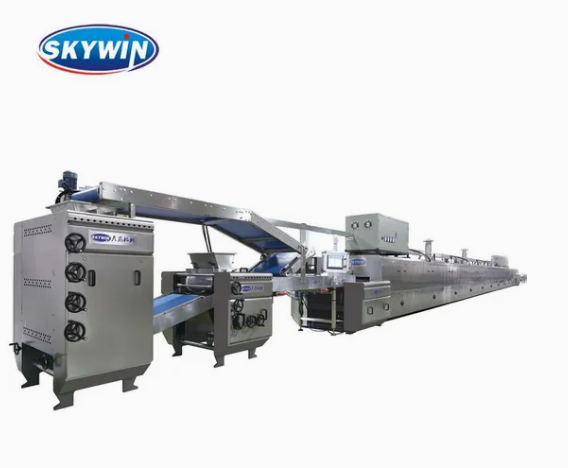
Many modern food manufacturers refuse to limit their operations to a single category. Installing a dedicated biscuit production line alongside a separate cookie line requires massive capital and floor space. Fortunately, modular engineering solves this dilemma.
The tunnel oven and cooling conveyors represent the most expensive segments of any baking facility. A modular layout utilizes a single, continuous baking and cooling system as the permanent anchor. You then utilize interchangeable forming modules at the front end. When you want to bake crackers, you roll the laminator and rotary cutter into position. When the schedule switches to chocolate chip cookies, you move the biscuit equipment aside. You then roll the wire-cut machine directly over the oven band feed.
This flexibility demands specific architectural planning. You need an extended front-end track. The factory floor must feature ample staging areas near the oven entrance. When the rotary moulder operates, the wire-cutter waits off the line. Heavy-duty casters and quick-connect power cables facilitate these changeovers. You must also align the central line axis precisely. Misalignment causes uneven baking and tracking issues on the main oven band.
Plant managers must weigh several operational trade-offs before choosing a hybrid system.
Pros: You achieve significantly lower capital expenditure than buying two distinct lines. You also ensure higher overall facility utilization. The oven rarely sits idle.
Cons: You will experience longer changeover times. Moving heavy machinery takes hours. You also face increased sanitation requirements. CIP (Clean-in-Place) protocols between runs must be rigorous. This prevents cross-contamination, especially regarding nut allergens commonly found in cookies.
Selecting the right machinery partner requires thorough technical vetting. You must look beyond standard marketing brochures. Focus on operational metrics, engineering tolerances, and food safety credentials.
You must align your target output (measured in kg/hr) accurately. Your production goals dictate the standard oven band widths. Most industrial systems utilize standard widths of 800mm, 1000mm, or 1200mm. Wider bands accommodate more product rows. However, they require perfectly balanced lateral heat distribution. You must calculate your desired baking times against the oven length. A vendor should provide an accurate baking curve simulation based on your specific recipe.
Global food safety standards evolve rapidly. Ensure your newly designed line meets strict regional regulations. Ask vendors about FDA, CE, and EHEDG compliance. You should actively look for wash-down capable forming equipment. Stainless steel 304 or 316 construction is mandatory for wet zones. The design must feature sloped surfaces to prevent water pooling. Tool-less removal of belts and scrapers dramatically accelerates the daily sanitation shifts.
Never request a generalized layout drawing from vendors initially. You must map out your current product formulations first. Develop a 3-year NPD (New Product Development) roadmap. Detail every inclusion, fat percentage, and desired throughput. Present this precise data packet to manufacturers. They can then engineer a layout matching your true commercial trajectory.
Request laboratory testing: Send your raw ingredients to the vendor's test bakery to validate the forming process.
Demand modular software: Ensure the line's PLC (Programmable Logic Controller) can store multiple recipe profiles for instant recall.
Verify local support: Confirm the manufacturer maintains a regional parts depot to minimize unplanned downtime.
The choice between a biscuit and cookie setup depends entirely on dough characteristics and specific forming methods. Attempting to run sticky dough through high-compression rollers leads to guaranteed mechanical failure. Understanding rheology ensures you deploy capital toward the correct engineering solutions.
For single-product facilities, purpose-built dedicated lines offer the highest Overall Equipment Effectiveness (OEE). They minimize changeovers and maximize continuous throughput. For contract manufacturers or rapidly growing brands, investing in a modular front-end system provides the best hedge against changing consumer trends. To take action immediately, audit your current recipes. Identify your dominant dough type. Then, engage with an equipment manufacturer to map a layout supporting your specific growth targets.
A: Yes, but only if the line was originally designed with sufficient space before the oven. You need adequate room to roll out the biscuit forming machinery. You can then install a standalone wire-cut or depositing module directly over the oven feed band.
A: Footprint depends entirely on output capacity and cooling time requirements. Even entry-level industrial lines typically require 30 to 50 meters of linear floor space. High-capacity operations often exceed 100 meters to accommodate adequate baking and cooling zones.
A: The downstream equipment, like flow wrappers and case packers, can often be shared. However, the collating and feeding systems must handle both the rigid nature of biscuits and the potentially fragile or irregular edges of baked cookies.


