


Views: 0 Author: Site Editor Publish Time: 2026-06-17 Origin: Site


Commercial baking carries high stakes for capital expenditure. Deciding how to upgrade equipment dictates long-term profitability. It also determines labor dependency and product consistency. Operations usually transition from artisan batch baking to industrial scale at a critical juncture. You cross this baseline threshold when manual methods cannot satisfy rising wholesale demands. Selecting the right automatic biscuit production line shapes your operational future. This article provides a comprehensive technical evaluation framework. Operations managers and procurement teams can use it to make evidence-based equipment decisions. You will learn how to assess production bottlenecks effectively. We will explore different system architectures and help you manage complex implementation risks.
Throughput is the primary metric: Semi-automatic lines are optimal for high-mix/low-volume facilities (under 100-200 kg/hr), while fully automatic systems are built for continuous, high-yield operations.
Labor vs. CapEx trade-off: Full automation drastically reduces ongoing labor costs and human error but requires significantly higher initial capital and skilled maintenance personnel.
Infrastructure constraints: Fully automatic systems demand extensive, uninterrupted floor space (often 50–100+ meters) and robust utility infrastructure (power, gas, cooling).
Integration risks: Upgrading to a comprehensive biscuit factory automation solution requires careful planning for downtime, operator retraining, and sanitary compliance.
Outgrowing a facility happens gradually, then suddenly. Production bottlenecks signal you need a robust equipment upgrade. Look for specific growth triggers on your factory floor. Inconsistent baking profiles often indicate human error during manual operations. Rising labor overhead eats into your profit margins daily. An inability to meet wholesale volumes means you leave money on the table.
We must contrast discrete batch handling against continuous processing. Batch systems pause between dough mixing and forming. Operators physically move carts of dough across the facility. Continuous operations feed dough without interruption. They maintain steady baking conditions inside the tunnel oven. This constant flow eliminates unwanted temperature fluctuations.
Manual touchpoints carry a high cost of inconsistency. Workers handling dough introduce unpredictable temperature variations. Uneven laminating or baking leads directly to high scrap rates. Wasted raw materials drain your financial resources. Automating these steps stabilizes the entire production cycle. You achieve reliable product weights and uniform coloring.
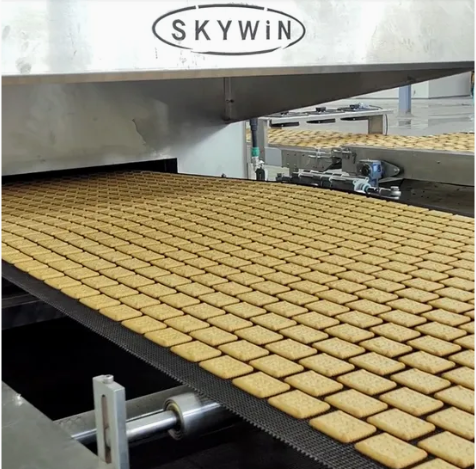
A semi automatic biscuit line offers a practical entry point for scaling operations. We define its core architecture by a calculated mix of automation and manual labor. Automated forming, baking, and cooling handle the heavy lifting. However, the system relies heavily on manual dough mixing. Operators manually feed hoppers and manage final packaging transfers.
This layout provides distinct operational advantages. You face a much lower initial capital expenditure. Facilities benefit from higher SKU flexibility. You can execute easier changeovers for diverse biscuit types. Operators can switch between hard dough, soft dough, and wire-cut varieties quickly. These systems also fit seamlessly into constrained or non-linear factory footprints.
You must also address inherent system limitations. The labor bottleneck remains a significant operational challenge. Manual transfer points create a higher risk of cross-contamination. Production faces a strict maximum capacity limit. You simply cannot push a semi-automatic setup beyond its manual feeding constraints. Best practices suggest using these setups specifically for niche or artisanal product ranges.
A fully automatic biscuit line engineers ultimate efficiency at an industrial scale. We map out its end-to-end integration across multiple complex zones. The system starts by executing automatic ingredient dosing. It moves seamlessly into continuous mixing and inline laminators. Rotary molders or cutters shape the dough perfectly. It then travels through long tunnel ovens before reaching robotic cooling and packaging stations.
Overall Equipment Effectiveness (OEE) drives this architecture. Minimizing human intervention maximizes overall equipment uptime. It ensures uniform baking profiles across thousands of biscuits. It also optimizes energy consumption per kilogram of product. Continuous systems recover heat more efficiently than intermittent batch ovens.
Modern systems prioritize sanitary and compliance design heavily. They feature advanced Clean-in-Place (CIP) capabilities. These built-in cleaning protocols minimize food safety risks dramatically. They help your facility meet stringent international hygiene standards. Eliminating manual handling reduces the bio-burden on your final product.
You need a structured framework to evaluate these two approaches. We start by calculating the throughput to ROI ratio. Upfront costs for full automation seem daunting initially. However, the system pays for itself over time. You achieve this through massive labor savings and increased daily yield.
We must contrast labor capabilities next. Semi-automatic setups require basic line workers for material handling. Full automation demands an entirely different skill set. You will need Programmable Logic Controller (PLC) technicians. You must hire mechanical engineers to maintain complex robotic arms.
Changeover times heavily influence your final decision. Full automation favors long, uninterrupted runs of a single product. Frequent recipe changes waste valuable time on a continuous system. Semi-automation allows for highly agile recipe changes. You can swap molds and dough types within minutes.
Evaluation Dimension | Semi-Automatic Setup | Fully Automatic Setup |
|---|---|---|
Throughput Profile | Optimal for under 200 kg/hr. | Built for continuous high-yield output. |
Labor Requirements | Relies on basic manual laborers. | Requires PLC technicians and engineers. |
SKU Flexibility | Highly agile for frequent recipe changes. | Prefers long, uninterrupted single-product runs. |
Facility Footprint | Adaptable to non-linear spaces. | Demands 50–100+ meters of linear space. |
Utility and footprint requirements dictate installation feasibility. Continuous tunnel ovens demand massive, uninterrupted floor space. Extensive natural cooling conveyors require significant overhead or linear clearance. You must ensure your electrical and gas grids can support continuous industrial loads.
Integrating a new line involves managing serious adoption risks. Installation downtime presents the most immediate threat to cash flow. You must integrate the new equipment into an existing facility carefully. Halting current production for weeks is rarely an option. Phased installations often mitigate this risk.
The "Weakest Link" principle governs continuous processing. A fully automatic line runs only as fast as its slowest component. Bottlenecks frequently occur at the cooling or packaging stages. If your wrappers fail, the entire oven line must pause or eject wasted product.
Spare parts and vendor lock-in require careful attention. We advise buyers to insist on non-proprietary wear parts. You should rigorously assess the manufacturer’s Service Level Agreement (SLA) for maintenance. Waiting weeks for a proprietary bearing will devastate your quarterly production goals.
Operator training creates significant organizational friction. Transitioning a workforce from manual handlers to automation supervisors takes time. You must invest in comprehensive training programs. Common mistakes include upgrading machinery without simultaneously upgrading workforce competencies.
Securing a comprehensive biscuit factory automation solution requires strict procurement criteria. We recommend creating a detailed checklist before approaching vendors. You must define exact success criteria to avoid scope creep.
Capacity Requirements: Define your minimum and maximum daily yield targets.
Available Footprint: Measure precise ceiling heights and structural column placements.
Utility Constraints: Audit your current gas, electrical, and water capacities.
Budget Limitations: Establish firm boundaries for initial capital expenditure.
Evaluating manufacturers goes beyond reading a specification sheet. You should look for companies possessing deep industry track records. Transparent Factory Acceptance Testing (FAT) protocols prove equipment reliability before shipping. Local support networks ensure you receive rapid maintenance assistance.
Your shortlisting logic should rely on hard engineering data. Advise your team to request detailed CAD layouts for your specific floor plan. Ask vendors for accurate utility consumption estimates. These data points separate capable engineering firms from mere equipment assemblers.
Neither system architecture is universally superior. Your ultimate choice hinges on the intersection of volume, budget, and product variety. Semi-automatic setups thrive in highly agile, diverse product environments. Full automation dominates high-volume, single-product continuous runs.
We urge decision-makers to audit their current yield data immediately. Quantify your daily scrap rates before initiating vendor conversations. Understanding your exact baseline metrics empowers you during negotiations.
Consult with a dedicated engineering specialist next. Map your factory floor accurately. Modeling a projected return on investment requires professional engineering insight. Take action today to future-proof your commercial baking operations.
A: Industry benchmarks typically suggest starting around 250 to 500 kilograms per hour. Regional labor costs heavily influence this threshold. Facilities facing high wage expenses often justify automation at lower volume levels. High production environments need automation to remain commercially competitive against wholesale market leaders.
A: Yes, but modular design realities limit seamless integration. Components like tunnel ovens scale exceptionally well. However, retrofitting automatic dough feeding to existing manual mixers proves difficult. It often requires replacing the front-end architecture entirely to achieve continuous synchronization.
A: You should prepare for extensive spatial parameters. A standard continuous setup easily requires 50 to 100 meters in length. Tunnel ovens alone consume significant space. Natural cooling conveyors usually dictate the longest continuous linear footprint required in your facility.
A: Standard high-volume items perform best on these lines. Marie biscuits, standard hard or soft dough varieties, and crackers are ideal. Highly delicate or heavily decorated artisan varieties often suffer. They typically require the gentle handling provided by semi-automatic processes.


