


Views: 0 Author: Site Editor Publish Time: 2026-03-24 Origin: Site


Labor costs represent a significant portion of operational expenses in biscuit manufacturing. Traditionally, producing biscuits required a substantial workforce for tasks such as mixing, shaping, baking, and packaging. However, automation has changed this landscape. Automatic biscuit making machine lines eliminate many of these manual tasks, allowing businesses to reduce their dependence on labor while increasing production output.
By implementing automation, companies can not only reduce labor costs but also improve product quality, increase production speed, and scale operations without the need to hire additional workers. The following sections will break down how automation in biscuit production saves labor costs, focusing on the key features of an automatic biscuit making machine line and its impact on labor-intensive tasks.
An automatic biscuit making machine line integrates multiple automated systems that work together to streamline the production process. Each machine in the line plays a critical role in reducing the need for manual labor and improving production efficiency.
The first step in biscuit production is preparing the dough, a process that traditionally required manual mixing of ingredients. In an automatic system, dough mixing machines are equipped with advanced technology to ensure uniform dough consistency.
Precision Mixing: Automatic systems can mix ingredients with high precision, ensuring that every batch has the same consistency.
Consistency: Automation eliminates variations that can result from human error, leading to consistent dough quality.
Higher Capacity: These machines can handle large batches, reducing the need for manual intervention during peak production periods.
After the dough is mixed, it needs to be shaped into the desired biscuit forms. Traditionally, this required workers to manually cut or shape the dough into individual biscuits. Automatic shaping and molding machines now handle this task with speed and accuracy.
Rotary Molders: These machines use rotary molds to shape biscuits at high speeds. They can produce different shapes and sizes of biscuits efficiently.
Depositors: For cookie-style biscuits, depositors dispense pre-measured amounts of dough onto baking trays.
Cutting Machines: Cutting machines are designed to precisely cut the dough into uniform pieces, ensuring each biscuit is the same size.
The next critical step is baking, which requires precise control of temperature and airflow to ensure consistent quality. Baking ovens are automated to manage these variables, ensuring that biscuits are baked evenly every time. Once baked, biscuits must be cooled, which also involves automated systems to maintain the right temperature and texture.
Convection Ovens: These ovens use fans to circulate hot air, ensuring even heat distribution and consistent baking.
Radiant Ovens: Often used for smaller batches, radiant ovens offer faster baking times but are less efficient in terms of heat distribution.
Cooling Conveyors: After baking, biscuits are cooled on automated conveyors, which help maintain their crispiness and prevent moisture buildup.
Finally, after the biscuits have cooled, they need to be packaged. Automated packaging systems handle the packaging process without the need for manual labor. These machines can wrap individual biscuits, pack them into boxes, and label them for distribution.
Flow Wrapping Machines: These machines wrap biscuits in plastic or foil to keep them fresh and secure.
Cartoning Machines: Cartoning machines pack multiple biscuit trays into boxes, streamlining the process and ensuring consistency in portion sizes.
The automation of the biscuit making process results in significant labor cost savings. By replacing manual tasks with automated systems, businesses can reduce the number of workers required on the production floor. Let's explore how each stage of the production process contributes to labor cost reduction.
In traditional biscuit manufacturing, high-volume production periods often required additional labor to keep up with the increased demand. With an automatic biscuit making machine line, however, the system can run continuously with minimal human intervention. This reduces the need to hire extra workers during peak production periods, saving both on wages and associated costs.
24/7 Production: Automated lines can operate around the clock without needing additional labor during off-hours.
Reduced Staffing Needs: The machines can perform tasks at a faster rate than human workers, reducing the need for a large workforce.
Lower Overhead Costs: With fewer workers needed for production, businesses can save on staffing, training, and management costs.
Human workers are prone to errors, especially during repetitive tasks like mixing, shaping, and packaging. These errors can lead to inconsistent product quality, defects, and rework. Automated systems, however, are designed to perform each task with precision, ensuring consistent quality without the risk of mistakes that can drive up labor costs.
Minimized Rework Costs: Automation reduces the likelihood of defective products, which means less time and labor spent on reworking or discarding bad batches.
Improved Quality Control: Automated systems can detect issues early in the production process, preventing quality issues from reaching the end product.
The speed of an automatic biscuit making machine line can also lead to greater efficiency, further reducing labor costs. Automation allows for faster production rates without compromising on quality, allowing businesses to meet demand with fewer workers.
Faster Production Times: Machines can work continuously without breaks, reducing downtime and increasing output.
Streamlined Workflow: Automated systems ensure smooth transitions between stages of production, minimizing bottlenecks and optimizing overall workflow.
Reduced Labor for Non-Production Tasks: With automation taking over the primary production tasks, workers can focus on maintenance and monitoring, requiring fewer staff members for day-to-day operations.
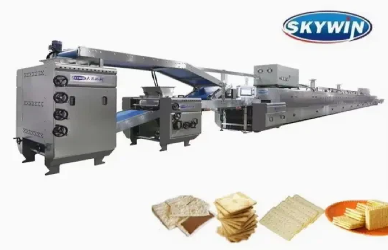
Beyond labor cost reduction, an automatic biscuit making machine line also boosts operational efficiency and allows businesses to scale production easily without needing a proportional increase in labor.
Automated systems are designed to run for extended periods without needing frequent stops for setup, adjustments, or repairs. This capability allows businesses to operate continuously, increasing production capacity without the need for additional shifts or workers.
Maximized Output: Continuous production ensures that machines are always in operation, making the most out of every working hour.
Reduced Downtime: Automation reduces the need for manual setup or intervention, minimizing downtime between production runs.
Higher Return on Investment: With machines running efficiently and consistently, businesses achieve a better return on investment over time.
One of the major advantages of an automated system is its ability to scale production. Whether you need to increase production to meet growing demand or reduce it during off-peak times, automation offers the flexibility to adjust without significantly increasing labor costs.
Adjustable Production Rates: Automated systems can be adjusted to meet changing demand levels without requiring additional staffing.
No Need for Extra Labor: Unlike manual production lines, scaling up production with automation does not necessitate hiring more workers or increasing labor costs.
Training workers to operate an automated system is simpler and less costly than training workers for manual processes. The technology in place often requires less hands-on involvement from workers, reducing the need for extensive training programs.
Simpler Training Programs: Workers are trained to monitor and maintain the automated systems, reducing the complexity and duration of training.
Less Training Staff: Fewer staff members are needed to oversee and train workers, further reducing operational costs.
A major benefit of automation in biscuit production is the reduction of labor-intensive tasks. Many aspects of biscuit manufacturing, such as dough mixing and shaping, are traditionally very physically demanding, requiring significant manual labor.
By replacing manual processes with automated machinery, businesses can minimize the physical strain on workers, reduce labor costs, and maintain efficiency.
Dough Mixing: Automation ensures that dough is mixed consistently without human intervention.
Shaping and Molding: Machines handle the shaping and cutting of biscuits, removing the need for workers to perform these repetitive tasks.
Packaging: Automated packaging systems eliminate the need for workers to manually wrap and box biscuits.
Manual tasks such as lifting, bending, and repetitive motions can lead to health problems for workers, including injuries and fatigue. Automation eliminates much of this physical strain, improving worker health and safety.
Reduced Physical Strain: Workers are less likely to suffer from musculoskeletal injuries due to repetitive tasks.
Safer Work Environment: Automated systems reduce the likelihood of accidents related to manual handling of heavy or hot equipment.
A1: Automation replaces manual tasks such as dough mixing, shaping, baking, and packaging, reducing the need for manual labor, especially during high-volume production.
A2: Yes, automated systems can operate 24/7 with minimal supervision, allowing for continuous production without additional labor during off-hours.
A3: Automation provides precise control over production parameters, such as temperature, speed, and ingredient ratios, ensuring uniform product quality without human error.
A4: In addition to reducing labor costs, automation minimizes defects, increases production rates, and allows businesses to scale efficiently without additional labor costs.
An automatic biscuit making machine line offers significant savings in labor costs by automating key aspects of production such as dough mixing, shaping, baking, and packaging. The automation of these processes leads to reduced labor requirements, greater production efficiency, and improved product consistency. As automation technology continues to evolve, businesses will have the opportunity to scale production without the need for a proportional increase in labor costs. Ultimately, adopting an automatic biscuit making machine line offers long-term financial benefits, enhanced efficiency, and improved product quality.


