


Views: 0 Author: Site Editor Publish Time: 2026-06-24 Origin: Site


Scaling cream biscuit production requires balancing high-speed throughput with precise filling accuracy. It also demands minimal product breakage. Production managers and facility engineers face a major transition when moving from semi-automated setups to high-capacity equipment. Upgrading involves significant operational restructuring. You need robust engineering solutions to maintain consistent output.
This guide outlines the technical specifications and integration requirements necessary for success. You will learn how to evaluate and procure a commercial machine without disrupting existing line efficiencies. We focus heavily on practical metrics. These include operational bottlenecks, system synchronization, and strict sanitation compliance. We provide actionable insights to help you build a reliable manufacturing process. You can use this resource to optimize equipment performance tailored to your specific product demands.
Capacity vs. Yield: True equipment ROI is measured not just by Sandwiches Per Minute (SPM), but by the reduction in biscuit breakage and filling giveaway.
Seamless Integration: Upgrading to a complete sandwiching and flow packing line eliminates secondary handling bottlenecks and reduces contamination risks.
Sanitation Standards: Washdown-ready designs (CIP) and food-grade stainless steel construction are non-negotiable for compliance and minimizing changeover downtime.
Vendor Accountability: Reliable procurement requires vetting vendors on Factory Acceptance Testing (FAT), local parts availability, and PLC integration capabilities.
Many production managers reach a plateau where current equipment limits profitability. You might start noticing inconsistent cream ratios across batches. Excessive labor hours required for manual sorting also eat into your margins. High product waste due to crushing is a major red flag. When these issues compound, operators must evaluate new technology. Upgrading your biscuit sandwich machine becomes inevitable to remain competitive.
What defines a successful equipment upgrade? We look at three main criteria for modern automated systems:
Achieving greater than 98% Overall Equipment Effectiveness (OEE) during peak shifts.
Standardizing cream and jam deposition weight to directly reduce costly ingredient giveaway.
Minimizing structural damage to fragile baked goods during the indexing and pressing phases.
We must also perform a critical assumption check. Higher running speeds do not automatically guarantee higher yields. If a machine lacks precise servo-motor controls for biscuit indexing, it simply produces waste at a faster rate. Advanced servo controls prevent misalignment. They ensure the top biscuit lands perfectly squarely on the base. You need precision just as much as you need speed.
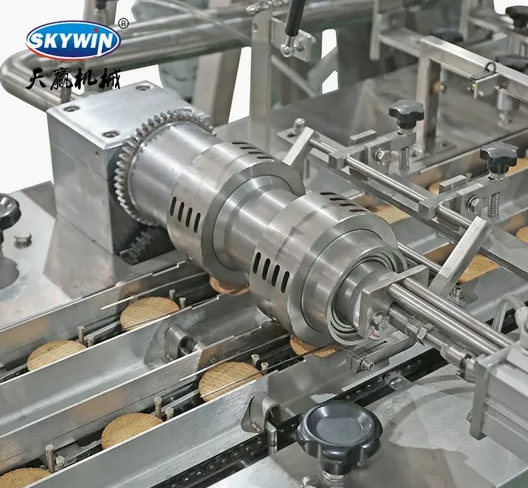
Operators must choose between standalone units and fully integrated ecosystems. Your choice depends entirely on your existing infrastructure and future production goals.
Standalone sandwiching units work well for facilities using modular packaging setups. You might have older wrapping stations you want to keep operational. Standalone designs offer flexibility for tight spaces. However, they carry notable drawbacks. They require manual transfer or custom conveyor bridging. This introduces extra handling. It increases the risk of biscuit misalignment before packaging. Misaligned products frequently jam the downstream wrapper.
An integrated sandwiching and flow packing line solves these transfer issues permanently. It suits high-volume, continuous production models perfectly. You achieve zero-touch automation. Biscuits move from the baking oven cooling phase straight into the final sealed package. It removes secondary handling bottlenecks entirely.
Integration relies heavily on precise synchronization. Programmable Logic Controllers (PLCs) drive intelligent timing belts. They ensure seamless handoffs between stations. The sandwiching output matches the flow wrapper infeed exactly. Smart sensors detect missing products. They instruct the wrapper to pause instantly. This logic prevents empty packages and saves wrapping film.
Lane Architecture | Typical Output (SPM) | Best Use Case Scenario |
|---|---|---|
1-Lane System | Up to 300 - 400 SPM | Boutique bakeries or specialty batch runs. |
2-Lane System | 800 - 1,000 SPM | Mid-sized regional production scaling up. |
4-Lane System | 1,600 - 2,000 SPM | High-volume continuous commercial output. |
6-Lane System | 3,000+ SPM | Global export lines paired with mega-ovens. |
Your machine must handle diverse fillings accurately. Aerated creams behave very differently than dense fruit jams. Peanut butter requires significantly higher extrusion force. Dual-color fillings need synchronized dual hoppers and specialized piping. A dedicated cream jam filling biscuit line uses tailored application heads to manage these varying viscosities.
Deposition System | Mechanism Overview | Ideal Filling Type |
|---|---|---|
Rotary Stencil Head | Rotating outer cylinder over a stationary dispensing block. | Firm, aerated creams and standard fats. |
Manifold Extrusion | Direct pneumatic or servo-driven piston extrusion through nozzles. | Sticky jams, peanut butter, and flowable liquids. |
Biscuit sorting and alignment mechanisms protect your overall yield. Vibratory chutes feed base biscuits into star-wheel indexers. These indexers handle slight variations in biscuit thickness automatically. They also accommodate minor diameter shifts without crushing the edges. High-end machines feature automatic rejection systems. Optical sensors spot broken or missing base biscuits. Pneumatic air jets blow the damaged pieces off the line before cream deposits. This proactive sorting prevents messy machine jams.
Drive and control systems require independent servo motors. We recommend robust platforms from brands like Siemens or Allen-Bradley. Servo motors replace outdated mechanical linkages and complex gearboxes. They allow operators to make precise speed adjustments instantly via a touchscreen. Troubleshooting becomes a software task rather than a mechanical teardown.
Floor space acts as a strict constraint in most facilities. You must factor in the required length for cooling conveyors. They sit prior to the sandwiching process. Warm biscuits will melt your cream filling upon contact. A proper layout ensures products reach ambient temperature first. You might need overhead cooling loops if floor space is heavily restricted.
Sanitation dictates machine design and long-term viability. We prioritize hygienic engineering guidelines to ensure food safety compliance. You must assess the ease of removing cream hoppers. Application heads should dismantle completely without tools. We strongly require IP65+ rated washdown components. The machine frame must feature sloped surfaces. Slanted stainless steel prevents water pooling after a harsh chemical washdown.
Changeover agility directly affects your uptime. Facilities rarely run a single product shape endlessly. You switch between round, square, or rectangular biscuits frequently. Tool-less adjustment features prove critical here. Guide rails and star-wheels should snap into place intuitively. Your ultimate goal is to keep mechanical downtime under 30 minutes during a product shape change.
Best Practices for Changeovers:
Use color-coded change parts for different biscuit shapes to prevent operator confusion.
Store change parts on a dedicated mobile shadow board right next to the machine.
Standardize hopper temperatures 15 minutes before the new run begins to ensure smooth flow.
Common Mistakes to Avoid:
Skipping or shortening the cooling conveyor phase to save floor space, resulting in melted cream.
Using high-pressure washdown hoses directly on non-IP65 rated optical sensors.
Ignoring slight wear on nylon star-wheels until they cause micro-fractures in the biscuits.
Evaluating a cream biscuit sandwich machine requires strict vendor vetting. You need equipment accountability long after the initial installation. We look closely at vendor testing protocols and their structural support frameworks.
Your procurement team must demand a documented Factory Acceptance Test (FAT). Never accept a FAT using generic materials or substitute ingredients. Vendors must test the equipment using your actual baked biscuits and your specific filling formulation. Moisture content, crumb structure, and sugar levels vary wildly between bakeries. A successful FAT proves the machine handles your unique recipe without stalling.
Examine the machine's spare parts list carefully. Do they use proprietary electronic components? This poses a major operational risk. You should insist on universally available commercial off-the-shelf (COTS) components. If a photoelectric sensor fails at 2 AM on a Sunday, you need the ability to source a replacement locally. Proprietary boards force you to wait for international shipping.
Finally, review the Service Level Agreement (SLA) terms regarding automation support. What is their guaranteed response time for remote PLC troubleshooting? Ask if they can remote-in via a secure VPN to diagnose a drive fault instantly. Clarify how fast they can dispatch a regional technician for critical mechanical failures. Fast remote diagnostics save hours of unnecessary downtime.
Selecting the right equipment hinges on aligning machine capabilities with your specific production targets. You must balance speed with gentle handling. Consider the following final steps to ensure a successful integration:
Align lane capacity closely with your oven output to avoid creating upstream bottlenecks.
Choose deposition heads based specifically on your filling viscosity and aeration levels.
Prioritize hygienic, IP65-rated designs to speed up daily sanitation processes.
Demand comprehensive, product-specific testing before approving delivery.
Next Step Action: Assemble your specific production data, including exact biscuit dimensions, required SPM, and filling viscosity charts. Present this data to your shortlisted equipment manufacturers and demand a customized FAT protocol tailored to your facility.
A: It varies heavily by lane count and biscuit size. Speeds typically range from 300 SPM on a single-lane system to well over 3,000 SPM on multi-lane, commercial systems.
A: Yes. Dual-deposit systems, known as co-extrusion setups, exist for this purpose. However, they require separate hoppers, independent temperature controls, and specialized manifold heads to work reliably.
A: Quality systems utilize high-speed optical sensors or mechanical gauges. These detect and automatically reject out-of-spec or broken base biscuits using pneumatic air jets before the cream is deposited.
A: Generally, expect a timeline of 3 to 6 months. This accounts for custom engineering, specific PLC programming, manufacturing, and mandatory FAT requirements before shipment.


