


Views: 0 Author: Site Editor Publish Time: 2026-06-17 Origin: Site


Commercial baking investments carry incredibly high stakes for any facility. Buying the wrong machinery quickly restricts production capacity. It inflates daily operational costs and severely compromises product consistency. Facility managers face a crucial choice between two dominant architectures. The decision between batch flexibility and continuous scale dictates your entire operational future. You need a reliable framework to evaluate these options accurately.
We designed this guide to help you match your oven architecture directly to your specific operational realities. You will learn clear, evidence-based metrics for making the right choice. We will explore volume thresholds, product specificities, and space requirements to guide your investment. Scaling a bakery requires more than just capital. It demands strategic foresight. Choosing between these ovens shapes your labor requirements and footprint layout for decades. Let us break down the engineering principles and real-world implementation strategies you need.
Production Style: Rotary ovens operate on batch cycles (ideal for diverse, multi-product bakeries), while a tunnel oven provides continuous inline production (essential for single-product scale).
Volume Thresholds: A tunnel oven is rarely justified for outputs under 500 kg/hour due to capital and footprint requirements.
Product Specificity: Items requiring precise, continuous baking times across massive volumes (like cookies or crackers) demand a dedicated biscuit tunnel oven.
Space & Capital: Rotary ovens maximize vertical space; tunnel ovens require extensive linear floor space and higher upfront capital, offset by lower per-unit labor costs at scale.
Understanding the fundamental engineering differences between these two systems is crucial. They represent entirely different philosophies of food production. One relies on discrete batches. The other relies on a never-ending flow of dough.
The mechanics of a rotary baking oven revolve around vertical space and forced convection. Operators wheel tall metal racks full of product directly into the baking chamber. Once inside, a motorized mechanism lifts the rack slightly and rotates it continuously. Ceiling-mounted fans blow hot air across the rotating pans. This ensures even heat distribution across every single tray.
The operational reality of this system heavily involves human interaction. It requires manual or semi-automated loading and unloading between every single baking cycle. When a bake finishes, an operator must physically extract the hot rack. They must then insert a new one. This cycle creates inherent downtime. However, it also offers immense flexibility. You can bake heavy artisan breads in one cycle, and delicate pastries in the next. You simply adjust the temperature and time on the control panel.
The mechanics of a tunnel oven are vastly different. These machines feature a motorized conveyor band moving steadily through a long, insulated steel tube. The product travels through multiple distinct temperature zones. You can set the first zone for high initial spring, the middle zone for through-baking, and the final zone for color development.
The operational reality completely eliminates batch downtime. This machinery integrates directly into automated makeup and packaging lines. Raw dough enters one end. Perfectly baked, cooling product exits the other. You experience zero loading or unloading interruptions during operation. The band never stops moving. This continuous flow maximizes throughput but demands rigid upstream consistency.
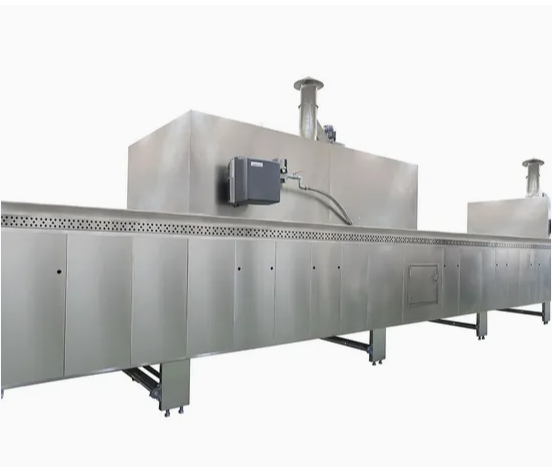
Continuous ovens represent a massive financial commitment. You must justify this expenditure through specific operational scenarios. They do not suit every bakery. They serve facilities aiming for industrial dominance in specific product categories.
You can easily justify this investment when running identical products for eight or more hours a day. The continuous band thrives on repetition. If your facility produces millions of identical hamburger buns weekly, batch processing becomes a logistical nightmare. The continuous system eliminates bottlenecks. It creates a steady, predictable output feeding directly into automated slicing and bagging equipment.
Certain products fundamentally require continuous processing. A specialized biscuit tunnel oven acts as the industry standard for wire-cut, deposited, or sheeted cookies. Handling individual trays of delicate cracker dough often leads to breakage. It also disrupts uniform moisture evaporation. A continuous band perfectly manages this delicate process. The dough sits undisturbed on a solid steel or wire mesh belt. The zoned heating extracts moisture precisely. This prevents checking (post-bake cracking) and ensures incredible uniformity across millions of units.
Finding and retaining skilled bakery labor grows more difficult every year. Continuous processing drastically reduces your headcount. It eliminates the need for operators to maneuver heavy, hot racks around a slippery bakery floor. This drastically reduces ergonomic risks. It cuts down on workplace injuries. At industrial scale, the labor overhead savings become substantial. A few skilled technicians oversee the control panels, replacing dozens of manual rack handlers.
These systems demand intensive upfront capital. However, the unit economics become highly favorable at specific thresholds. Once your output exceeds 1,000 kg per hour, the efficiency gains compound rapidly. You use less fuel per kilogram of dough. You employ fewer people per shift. Your product waste drops due to automation consistency. These factors create highly predictable return on investment timelines for large-scale operators.
Continuous lines fail miserably when tasked with extreme variety. Many wholesale and retail bakeries thrive by offering vast catalogs of baked goods. For these businesses, batch processing remains the superior choice.
This is the definitive choice for bakeries producing ten or more different items daily. You might bake crusty sourdough breads at 5 AM. By 8 AM, you switch to delicate croissants requiring low heat. By noon, you bake dense muffins. Each product demands radically different temperatures, steam profiles, and bake times. Rack rotation handles this effortlessly. You simply change the program between batches. Continuous bands cannot accommodate such rapid temperature swings.
Most commercial spaces lack infinite floor space. This batch equipment capitalizes on vertical height rather than linear length. The baking chamber goes up, not out. You can fit multiple units into standard commercial retail footprints or mid-sized wholesale floors. They tuck neatly against walls or into corners. This allows urban bakeries to maximize their expensive real estate effectively.
Growing businesses often cannot afford a single, massive capital expenditure. Batch systems allow you to scale incrementally. You can follow a sensible growth path:
Phase 1: Purchase a single unit to handle initial wholesale contracts.
Phase 2: Add a second unit as your customer base expands, doubling capacity.
Phase 3: Introduce a third unit to separate high-temp bread baking from low-temp pastry baking simultaneously.
This strategy protects your cash flow. It matches your machinery investments directly to your actual revenue growth.
Making a final decision requires comparing these architectures across key operational metrics. We will break down efficiency, space, and integration readiness.
Energy consumption heavily influences daily profitability. You must evaluate energy loss accurately. Batch ovens lose significant heat every time the doors open for rack swaps. The chamber temperature drops. The burners must fire aggressively to recover that lost heat. This continuous cycle of loss and recovery wastes fuel.
Conversely, continuous systems maintain steady-state heat retention. The doors never open. Modern facilities increasingly rely on energy-saving baking equipment. Modern continuous lines feature advanced heat recovery systems. They utilize modulating burners and sophisticated exhaust recycling. They might have a higher total BTU rating, but they offer superior fuel efficiency per kilogram of dough baked. They trap heat and use it relentlessly.
Your building dictates what you can install. You must define the structural prerequisites before requesting quotes.
Continuous lines require massive linear space. They often span 10 to 50 meters or more. Your facility needs reinforced flooring to support their immense static weight. You also need complex, multi-point exhaust routing through the roof. Batch systems require high ceilings for rack clearance. They also demand highly durable floors in front of the doors. Constant rack wheel traffic quickly destroys standard concrete.
Operational Architecture Comparison
Feature | Batch Architecture | Continuous Architecture |
|---|---|---|
Space Orientation | Vertical footprint | Horizontal/Linear footprint |
Installation Time | 1 to 3 days typically | 4 to 8 weeks typically |
Product Flexibility | Extremely high (cycle by cycle) | Low (requires identical runs) |
Minimum Viable Output | Under 100 kg/hr | 500+ kg/hr minimum |
Labor Dependency | High (manual loading/unloading) | Low (fully automated flow) |
You must analyze upstream and downstream readiness. A continuous band is entirely useless if your mixing stations cannot keep up. If your packaging department cannot process 1,000 cookies a minute, the continuous line will bury them in product. The entire factory must match the oven's pace.
Assess batch systems as standalone islands of production. They operate independently. If a mixer breaks down, the oven simply waits. Assess continuous systems as central nodes of a fully automated line. Everything connects. What to watch out for: Never install a continuous band without simultaneously upgrading your cooling conveyors and automated wrappers.
Theory often clashes with factory floor realities. Installing industrial machinery involves significant disruption. You must plan for installation delays, mechanical failures, and product transitions.
Time is money. You can often install and commission a batch oven in mere days. They arrive in large pre-assembled sections. Technicians connect the gas, water, and electricity quickly.
A continuous line requires weeks of complex assembly. Technicians must weld sections together on-site. They spend days conducting zone calibration. They must perfectly balance the band tracking adjustments. If the heavy steel band wanders even a few millimeters, it destroys itself against the frame. This commissioning process halts production in that area of your facility for weeks.
Automation introduces systemic risk. If a continuous band stops due to a mechanical fault, the entire production line halts. Raw dough backs up at the makeup station. Baked goods burn inside the chamber. You must emphasize strict preventative maintenance protocols.
Daily visual inspections: Check belt tension and burner ignition sequentially.
Weekly lubrication: Grease all high-temperature bearings along the drive path.
Monthly exhaust audits: Clear carbon buildup from extraction flues to prevent fires.
Quarterly sensor calibration: Ensure thermocouples report accurate zone temperatures.
Changing product profiles on a continuous line introduces severe complexities. You cannot simply press a button and switch from heavy buns to light rolls. It requires "empty band" time. You must let the current product exit completely. Then you perform zone-temperature resets. You must wait for the heavy steel chamber to cool down or heat up to the new specifications. This causes significant yield loss and downtime not present in batch baking.
Choosing the right baking architecture determines your long-term success. You must align your equipment with your actual business model. Summarizing the shortlisting logic is simple. Do not buy a continuous line for flexibility. Do not buy a batch rack system for industrial-scale continuous output. Each machine serves a distinct, uncompromising purpose.
Your immediate next steps involve hard data collection. First, conduct a thorough SKU-volume analysis. Determine exactly how many kilograms of each product you bake daily. Second, measure your available linear floor space down to the centimeter. Third, audit your current upstream automation capabilities. Ensure your mixers and makeup lines can support continuous flow. Complete these three steps before you ever request manufacturer quotes.
A: You generally need to produce 500 to 1,000+ kg per hour to justify the investment. Outputs below this threshold rarely offset the massive initial capital and extensive linear footprint requirements. High-margin specialty products might justify smaller continuous setups, but standard industry baselines strongly recommend exceeding 500 kg/hr for optimal unit economics.
A: Yes, but with caveats. The mechanical rotation effectively mitigates severe hot spots within the chamber. However, manual batch-loading introduces variables. Opening doors causes temperature drops. Operator delays in loading can alter resting times. These human variables introduce minor inconsistencies across different batches, whereas a continuous band eliminates them entirely.
A: Yes, at scale. While their total BTU consumption appears massively high, their energy cost per unit baked is actually lower. They operate on continuous heat retention. They do not lose heat through frequent door openings. Their massive thermal mass and advanced heat recovery systems optimize fuel usage for high-volume continuous runs.
A: Rarely. They feature highly specialized designs. The band types differ entirely—solid steel or tight wire mesh for cookies, compared to heavy grids for panned breads. Furthermore, clearance heights in cookie systems are notoriously low to maximize radiant heat transfer. They simply lack the vertical space to accommodate rising breads or tall cakes.


